
ABOUT PROCESS
PROPEL is focused primarily on educating and advocating for policy issues that can help San Francisco solve socio-economic problems more equitably, and ensure all our communities are thriving. We’re also a 501c4, though, so we do have thoughts about candidates – although you won’t often find us wading into debates about people specifically, particularly in non-competitive races. We would welcome the opportunity to have any politician or community leader take up the progressive policies we’re promoting – but also know it requires political courage and hearing from everyday San Franciscans ready to hold politicians accountable. We all have a role to play! The candidates reflected in these endorsements are those who have proven themselves able to walk the talk – and at minimum, will be independent public servants representing their constituents and not pay-to-play corporate donors.
PROPEL’s Board of Directors voted this month to forward the below endorsements – thanks to those of you who wrote in with comments or questions in advance of the vote. *(Please note: if you don’t see a candidate race or ballot measure reflected, that’s because the Board opted not to endorse or weigh in.)
THE 4-1-1 OF VOTING IN THE 4-1-5
REGISTER TO VOTE
You can register to vote at any U.S. Post Office or online at RegisterToVote.ca.gov. If you’re registered by October 19th, you’ll get a ballot in the mail – (despite Trump’s egregious attacks on mail-in ballots, our Director of Elections, John Arntz, has issued a reassurance that “there are no changes to USPS ballot delivery or return services,” and that DOE will continue to support “free, fair and functional elections”) – so take heart! ♥️
But also: in SF you can always register in person at City Hall up until Election Day. You can also register at any polling place on Election Day: just ask to cast a provisional ballot. Call 415-554-4375 for more info, or to report any challenges with day-of registration.
WHEN:
October 5th: Early voting starts at City Hall, weekdays only 8:00am-5:00pm.
October 24th: Weekend early voting starts at City Hall, Saturdays and Sundays 10:00am-4:00pm.
November 3rd: Election Day! Polls open 7:00am-8:00pm. If you’re in line by 8pm, you can vote! You can also drop your ballot off at any polling place on Election Day.
WHERE:
Everyone will get a ballot in the mail! Make sure yours is coming to the right place by checking your registration at SFElections.org.
Mail your ballot if you can't drop it off. You don't need a stamp, but make sure you sign the envelope, and make sure that it's postmarked by November 3rd.
Drop off your ballot early at one of the 37 official ballot drop boxes across the City, from October 5th through 8:00pm on Election Day, November 3rd.
Where’s your polling place? Check https://SFelections.org/tools/map_poll_time/, call 311, or just go vote at City Hall.
WHAT ELSE:
Did you forget to register? You can still vote! Go to City Hall or your polling place and tell them you want to "register conditionally and vote provisionally!" Get that collectible “I VOTED!” sticker!
People with felony convictions can vote! You can vote even if you’re on parole, so exercise your rights!
Team ‘em young! If you’re 16 or 17, pre-register and your registration will automatically be activated when you turn 18 years of age – get a jump start on making your voice heard!
Any other voter guides that PROPEL is aligned with or that provide substantive research on issues? YES! Check out SF League of Pissed Off Voters’ always-informative and thoughtful voter guide, complete with Cheat Sheet for the polls. (And DON’T get tricked by imposters or imitators - there’s only one SFLPOV, and it’s NOT run by multi-millionaire Super PACs!)
The Short ‘n’ Sweet: Key Endorsements
Congressional, State and San Francisco Offices
Congress D11: Connie Chan
Attorney General: NO ENDORSEMENT
CA Insurance Commissioner: Jane Kim
Public Defender: Mano Raju
D2 Supervisor: No Endorsement
D4 Supervisor: No Endorsement
D6 Supervisor: No Endorsement
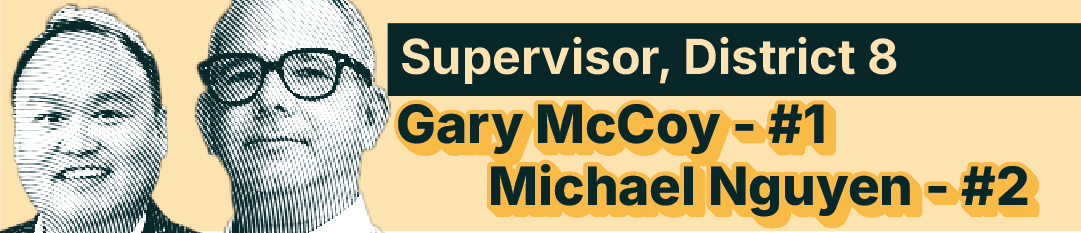
D8 Supervisor: Ranked Endorsement: #1 Gary McCoy, #2 Michael Nguyen
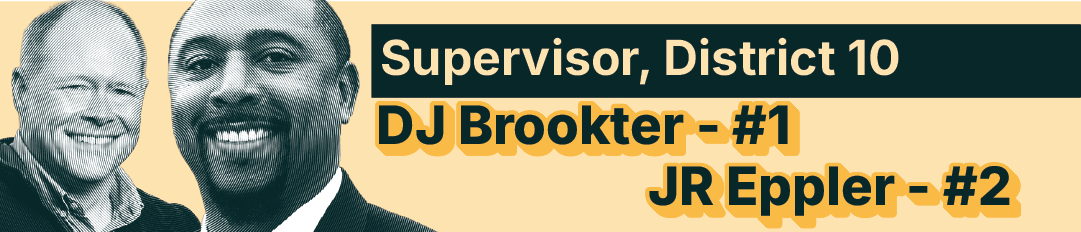
D10 Supervisor: Ranked Endorsement: #1 Dion-Jay “DJ” Brookter, #2 JR Eppler
School Board: Virginia Cheung, Reina Tello, Ryan Hazelton
College Board: Leah LaCroix, Bunny McFadden, Jeremy Lee
Prop A: Charter Changes Eliminating/Limiting Voter-Approved Oversight: No
Prop B: Public Bank: Yes!
Prop C: Increase Housing Trust Fund: Yes
Prop D: Make It Harder for Anyone But Rich to Submit Ballot Measures: No!
Prop E: Charter Changes Limiting Contract Oversight: No
Prop F: Gut Charter To Consolidate Mayoral Power: No!
Prop G: Great Highway Compromise: No
Prop H: Parcel Tax to Fund Muni: Yes
Prop I: Affordable housing guarantee act: Yes!
Prop J: Remove foreclosure exemption from property transfer tax: Yes
Prop RTM: Regional Transit Sales Tax: Yes
Statewide Propositions
Prop 40: Billionaire wealth tax: Yes!
Prop 41: Require pre-election audit for voter-passed taxes: No!
Prop 42: Limit state ability to raise taxes: No!
Prop 43: Limit local voters' ability to pass local taxes: No!
PROPEL NOVEMBER 3, 2026 Endorsements
Races to rep San Francisco

CONGRESS, DISTRICT 11: CONNIE CHAN
You can read our early June endorsement of Connie Chan for Congress here, and our subsequent thoughts from our post-election debrief here.
Since June, Connie has racked up even more endorsements, including from her former opponent, Saikat Chakrabarti, whose newly-created Solidarity PAC has invested in building out her reach. It’s a promising collaboration, and an example of the kind of big tent collaboration that we need more of on the progressive left. At a time when electoral politics has turned many voters off with its insane corporate spending, insider baseball and toxic attacks, it’s refreshing and hopeful to see progressives working to support each other through resource sharing and policy cross-pollination.
With relentless attacks on her housing track record, we wanted to provide an additional note about why Connie is our Affordability Agenda Champion:
Connie has a long history of supporting affordable housing and tenants, in direct contrast to her corporate-backed opponent, Scott Wiener, including:
Sponsored the Affordable Housing Production Act to spur truly affordable housing development without compromising strong labor protections and building housing that workers can actually afford.
Advocated for affordable housing projects, including a 98-unit 100% affordable housing development completed in the Richmond.
Advocated for greater funding for affordable housing, including $30M for survivors of assault
Passed legislation to create 76 units of housing while preserving local history at the former Alexandria Theatre site
Passed legislation to strengthen San Francisco’s first-in-the-nation “Union at Home” program, expanding tenant protections against predatory landlords and strengthening tenants’ ability to organize their buildings
Co-sponsored the “Tenant Opportunity to Cure; Eviction Protections”, which helped keep thousands of tenants in their homes during the pandemic
Restored funding to support residents of single-room occupancy buildings as Budget Chair, after Mayor Lurie cut the critical funding for SRO’s
Yes, we were disappointed that Connie chose not to support the Affordable Housing Guarantee Act (along with Wiener) and frankly has been unable to articulate a compelling policy reason why. (Big Real Estate – as a major driver of the affordability crisis – should absolutely pay its fair share to build desperately-needed affordable housing. Period.) But… it’s a political jungle out there, and this is a long game to finally get a champion for working people to D.C. – who will hopefully fight for a much bigger slice of the pie on Capitol Hill for us all. Based on Connie’s previous progressive track record as a legislator and tenant advocate, we are supporting her all the way to D.C.
Getting Connie to Congress would be a game-changer for San Francisco. So we’re maintaining our June endorsement, and hope you will vote for her.
Attorney General: No Endorsement
Rob Bonta is a massive sell-out and Americans must stop voting for weak-sauce Democrats who undermine our democracy and cave to the very corporate interests driving our affordability, economic, public health and environmental crises. Where to begin with the rage we felt watching Bonta and Newsom cave to the Larry Ellison empire in the disastrous Paramount-Warner Bros. merger. The fact that it happened the same week as Trump’s targeted press ban was just icing on the dog $h!# pile.
What even is the point of anti-trust laws if politicians won’t enforce or defend them? The sweetheart deal not only facilitates extreme market concentration, but permits sovereign Middle Eastern wealth funds roughly 50% equity stake in critical American media. It threatens tens of thousands of jobs, paves the way for more AI slop and rising consumer costs, further knee-caps journalistic independence, and restricts access to truly independent creative projects. Worst of all, we got sold for a song – because the whole deal is predicated on the good word of Larry Ellison and totally unenforceable.
Even modest concessions sunset within five years. There are no divestitures. And granting these corrupt oligarch owners oversight of the editorial independence of CNN and CBS News (?!?!) just feels like a sadistic joke.
So, no: we cannot endorse any candidate (whether Democrat or Republican) who is not willing to choose the People of California over Corporate Oligarchs. This is not a drill: our democracy is dying right before our very eyes. And as long as we still have the right to vote, we must use it to hold politicians accountable.

STATE INSURANCE COMMISSIONER: JANE KIM
Speaking of politicians who will hold corporations accountable: Since sweeping the June primary (and securing more votes statewide than Bernie Sanders did in his presidential run in California!) Jane Kim has continued to highlight the corrupt and largely unregulated insurance industry that is driving up costs for working Californians. We endorsed her back in June, based on her track record and platform – and we’re excited to double down on that support as Jane faces a deluge of dark money in her fight to represent us all.
When we say deluge: crypto-billionaire Chris Larsen recently dumped a record ONE MILLION DOLLARS into opposing Jane’s platform of a more affordable and accountable insurance system in California. It’s just bonkers spending from untouchable Tech Oligarchs who have spoken very publicly about controlling government and buying elections.
We believe in the work that Jane Kim has been doing for years – and the powerful progressive coalition she has helped build that can hopefully be sustained for other electoral and movement fights. Vote Jane Kim for this unprecedented shot at transformative change for California!

PUBLIC DEFENDER: MANO RAJU
This is not a contested race, but the Board felt compelled to weigh in on why we are lucky to have Mano Raju as our public defender. San Francisco is the only city in California to elect its public defender by a vote of the people. That’s important, given that the office serves approximately 25,000 people annually who would otherwise not have access to legal counsel.
Mano has continued the proud tradition of SF public defenders before in broadening the scope of his office to support criminal justice reform, education and successful re-entry models. He has also gone beyond representing clients in court to publicly calling out abuse in our jails, racism in our courtrooms, and failing policies in our justice system. One recent example: exposing the overcharging which dumps people in overcrowded jails, creates crushing workloads for attorneys and staff, and wastes jurors’ and judges’ time. (A recent scorecard highlighted eye-popping numbers underscoring this failed tactic: while State prosecutors lose trial cases 14% of the time, San Francisco prosecutors lose a whopping 52% of the time, meaning they are bringing cases that don’t pass legal muster.)
As for education, Mano has helped steer DEFENDER, an art & media project that “...brings to light stories of the people and communities most affected by inequities of the criminal legal system, and aims to promote a culture of reform through the language of art and media.” Shout-out to our friends at Even/Odd productions who have brought the PD’s transformative success stories to life.
Board of Supervisors D2, D4, D6: No Endorsement
We’ve said almost everything there is to say about Districts 2 and 4 in our June primary write-up. Since riding an obscene wave of Big Tech money into office back in June, Supervisors Stephen Sherrill and Alan Wong have performed pretty much as expected, advocating for 14% raises for the SFPD (who rank among highest paid in the Bay Area and California, not including their astounding overtime compensation which has put many at $800,000 annually), approving poorly graded contracts like OpenAI and Flock surveillance, and failing to support key tenant protections at a time when SF is experiencing record evictions.
District 6 incumbent, Supervisor Matt Dorsey, did not have a June special election, but is (essentially) running unopposed due to lack of a financially viable opponent in a tough district to campaign in. Supervisor Dorsey’s tenure has also been marked by a shift to the right, including vocally opposing and defunding successful and internationally recognized Housing First policies.
For all of these reasons and more, PROPEL’s board could not support endorsements of any of the incumbents.
DISTRICT 8 SUPERVISOR: #1 - GARY MCCOY #2 - MICHAEL NGUYEN
Gary McCoy has differentiated himself from his lead opponent, cafe owner and political gadfly Manny Yekutiel, in several ways. Gary’s lived experience as a recovering addict and survivor of homelessness have informed a public service career in City Hall and beyond, on issues ranging from public health to housing. As the former Vice President at Healthright360, Gary worked with the Department of Public Health to strengthen healthcare services to over 9,000 low-income individuals annually, and has been an articulate champion for Housing First policies which, (despite having a 80%-90% success rate of keeping people housed after one year and being proven to reduce public costs, including emergency room visits, hospitalizations, and jail stays), have come under relentless attacks from the Trump administration.
But Gary has not just been an advocate and policy expert in homelessness and substance abuse treatment, he is also very familiar with how our healthcare system works. As the former campaign manager for Congresswoman Nancy Pelosi’s ongoing “Save Our Healthcare” campaign, he has been rallying community against the Trump administration's attacks on Medicaid, Medicare and the repeal of the Affordable Care Act.
He supports housing for people across ALL income levels by protecting tenants’ rights, fighting for increased public investment in housing infrastructure, and cutting red tape that makes it challenging for non-profits to develop new affordable housing. He’s a champion for the public infrastructure powered by working class labor, from increased investment in public transit to the workers that teach our kids, clean our streets and maintain our sewers. And unlike his opponent, Manny Yekutiel, he does not support SFPD’s contract with scandal-plagued surveillance company, Flock.
He is someone with personal and working relationships across the political spectrum, and a pragmatic and independent public servant, as a result. He understands governance, diplomacy and policy-making – all areas of expertise lacking on the current Board of Supervisors overall. And he will prioritize the issues that deserve top attention, not just in District 8’s neighborhoods but citywide. He is our top pick for District 8 Supervisor, as a result. Read more about Gary McCoy.
We also recommend Michael Nguyen as a #2 in this local ranked-choice race. As an attorney, and community organizer, he is uniquely positioned to understand the intersection of how changes to law can help or hurt communities. As an established drag performer, he also understands the importance of art & culture to our local economy and identity. As a longtime SF renter, Michael is very clear about his support for protecting and expanding rent control, as well as the need for a clear housing continuum to permanent affordability. Finally, his experience as the child of refugees has reinforced his commitment to investing in immigrant support services, which we need now more than ever. He’s a Working Families Party member, and also endorsed by our friends at the Harvey Milk Club LGBTQ Dem Club. We endorse Michael Nguyen #2 for D8 supervisor. Read more about Michael Nguyen and his platform here.
As for former political fundraiser and professional party planner, Manny Yekutiel, let’s start with his lack of policy and governance experience. As a political appointee to the SFMTA Board, he seemed more interested in ratcheting up his name ID and building political connections, then weighing in to tough decisions on Muni operations, budget cuts and senior and disabled access to transit. His rationale for supporting even more police budget increases with less accountability have been political, rather than based in data or facts. Throughout his campaign, when asked about his platform he has leaned on the cop-out of “I don’t know what I don’t know, so I’m just on a listening tour.” The Board of Supervisors really need public servants that understand how the public sector works, and are prepared to do more than rubber stamp contracts and throw block parties – as fun as street parties can be! We are living in an unprecedented time of toxic pay-to-play politics, where large corporations and billionaire CEO’s are paying hundreds of millions of dollars to consolidate power, take over government, and extract every last cent and resource from hard-working American families – especially in San Francisco, where a concentration of mega-wealth has driven up the cost of living for everyone else. We really need experienced legislators who are committed to the hard work of fighting for our democracy (not taking donations from the people dismantling it).
Finally, beyond the critiques of his policy positions, Manny Yekutiel has been credibly accused of sexual assault. This is an automatic disqualifier, and we were very disappointed to see Mayor Lurie (who had indicated he would stay out of the race), weigh in recently to support his business partner, who he co-founded Civic Joy Fund with as a part of his downtown revival project. Sexual assault and harassment continue to be a major problem in the halls of power, starting at the very top of our federal government with President Trump. If we are going to create a positive and safe environment for a new generation of diverse leaders to work for the public good, we MUST draw a line and hold politicians accountable for their harmful actions – and we must push for a real culture shift to prioritize the needs of survivors, versus publicly shaming and silencing them. For all these reasons, we cannot support or rank Manny Yekutiel.
*Note: Since the original writing of this endorsement, more credible allegations have come out against Manny Yekutiel, triggering a domino effect of high-profile endorsers pulling their endorsement. We appreciate that politicians are starting to take survivors more seriously, but it should not take political pressure to believe survivors. Regardless if there was one victim or ten, regardless if the survivor is progressive, neo-liberal or conservative, regardless if the sexual assault was once or multiple times, to actually end the pervasive rape culture in San Francisco’s halls of power and beyond, politicians have got to stop making excuses for powerful men. Period. Manny Yekutiel should drop out of the race and focus on repairing the damage he has perpetrated.
DISTRICT 8 SUPERVISOR: #1 - DJ BROOKTER #2 - JR EPPLER
Supervisor Shamann Walton will be termed out this November, and the competitive race to succeed him has narrowed down to top three candidates Dion Jay “DJ” Brookter, Theo Ellington, and J.R. Eppler. District 10 (comprised of the Bayview/Hunter’s Point, India Basin/Candlestick, Visitacion Valley, and Potrero Hill) continues to be one of the last hold-outs for working class families in the city, and has absorbed an incredible amount of development in its mixed-use and formerly light industrial areas. That development has brought more housing (good), though with mostly market-rate rents, contributing to gentrification pressures on small businesses, renters, and cash-poor/house rich homeowners. Even more alarming than a dearth of affordable housing is the increased attention the district is receiving from developers looking to bend zoning laws and exploit loopholes to build data centers, AI facilities and Amazon distribution centers. Coupled with the district’s ongoing environmental justice issues caused by years of unremediated toxic infill at the Hunters Point Shipyard, there are plenty of reasons why District 10 deserves to have an independent voice and champion on the Board.
Dion-Jay “DJ” Brookter is Supervisor Shamann Walton’s endorsed successor, and has previous administrative and community development experience as the former executive director of both the Southeast Community Facility Commission and most recently affordable housing non-profit Young Community Developers (YCD). He’s also served on the Sheriff’s Oversight Board, the Police Commission, and the General Obligation Bond Oversight Committee, which audits and reviews voter-approved bond spending to make sure the government is doing its job with the people’s money. Brookter is an expert in affordable housing development and financing, as well as neighborhood planning that includes community benefits and infrastructure. He is pro-Labor and prepared to put his experience as a workforce provider to good use helping young people create upward mobility with good living wage jobs. He supports protecting and expanding rent control, Prop B’s Public Bank measure, Prop I’s Affordable Housing Guarantee Act, and full accountability from the Navy around their intentionally botched shipyard clean-up. He is our top pick to continue Supervisor Walton’s legacy of independent voting and community-first policy making.
Attorney and Potrero Hill neighborhood leader, J.R. Eppler, has a long history of advocating for “complete neighborhoods” with affordable housing, small business protections, pedestrian safety infrastructure, quality schools and parks. He has been an engaged advocate for community voice at an increasingly privatized City Hall, and will also be an independent vote on the Board. We are ranking J.R. #2.
As for Theo Ellington, given his past career as a lobbyist and booster for Big Tech and Big Real Estate (which has garnered him record-breaking outside spending in this race from the same people who stand to profit from his win) we cannot support or rank him.
*A note on Ranked-Choice Voting from one of our favorite community leaders, Dr. Saidah Leatutufu-Burch: “How to RCV” – it’s important!

SF BOARD OF EDUCATION: VIRGINIA CHEUNG, REINA TELLO, RYAN HAZELTON
We are endorsing this strong slate of pro-public education candidates for several reasons.
The past several years, SFUSD has been thrown into turmoil, largely due to poor leadership from a revolving door of Superintendents and a Central Office that has struggled with disinvestment and austerity budgeting, bad communication with parents, and a teacher payroll disaster of its own making. As grueling as the pandemic was, it was also a teachable moment and opportunity to fight for a better public school system for our students, families and teachers. PROPEL covered this past year’s budgeting debate here, and were impressed that all three candidates had a strong vision for restoring trust in SFUSD’s budget process with data and accountability, centering investments on students, and having a longterm vision for building out the pipeline for K-12 in San Francisco. They also clearly understand the connection between building out our school population and the need for a citywide afforability strategy.
They rightly pointed out that the School District’s poor budgeting has been overseen by the incumbents on the Board of Education, starting with mayoral appointee and Board President, Phil Kim. Depending on which side of the teachers’ strike you were on, you likely have strong feelings about Phil Kim’s push to extend the strike when the District was ready to reach a settlement agreement. But while PROPEL staff were definitely out on the picket lines supporting our teachers and families, this isn’t actually why the Board is not supporting Phil Kim.
Whether you have children or not, and whether they are in the public school system or not, if you are registered to vote, you have the privilege of weighing in to help determine SFUSD’s oversight. And that makes us all responsible for the well-being and success of San Francisco’s students and the teachers shaping their futures. That means we really need subject matter experts in the areas of education and public investment. The Board of Education has not done a good job of managing the budget, and has not given good direction to the Superintendent around investment priorities. The District’s own numbers have clearly shown that we have the money to invest in our kids now, and SFUSD leadership has chosen disinvestment. The federal government is already dismantling our public education system, which is one of the pillars of any healthy democracy. We must support political leadership that wants to build a bold future for SFUSD, not operate from a place of fear and inevitability. Virginia, Ryan, and Reina all have an understanding of good government budgeting – and have pledged to flip the failing status quo by prioritizing public investments in today’s kids and rebuilding trust with parents and taxpayers.
And, particularly in light of the Mayor’s recent tonedeaf move to appoint all private school students to the City’s only youth representation body, we are excited to support two smart public school moms and an afterschool provider serving public school kids. They have interesting ideas about how to finally get “Baby Prop C” funds out the door and to the families that need the subsidies, while building out SFUSD’s early childcare sites so that we can bring more new parents into the SFUSD pipeline who will hopefully stay. They’re positive and representative of a diversity of neighborhoods and communities – we’re happy to see this kind of energy repping one of the most wonderful treasures in San Francisco: our public schools! *(Note: all three are endorsed by the United Educators of San Francisco, the SF teachers union).

CITY COLLEGE BOARD OF TRUSTEES: LEAH LACROIX, JEREMY LEE, DR. BUNNY MCFADDEN
What an incredible and committed roster of candidates to help turn our City College crisis around. Bunny, Jeremy and Leah are three smart and committed community leaders who have impressive track records advocating for affordable and quality education, accountable government and effective progressive policies. They bring a fresh energy and perspective to a board that has for too long been a stepping stone for rubber stamps looking to run for higher office (Supervisor Alan Wong, case in point…)
Dr. Bunny McFadden is a former high school & community college educator and actually attended community college, which is an important inside perspective to bring to the conversation! She holds a doctorate in education, and has put her policy chops to good use, opining on everything from city budgets to public infrastructure and arts & culture advocacy. She is a current nonprofit education board member and former PTA President. Most of all, she cares about restoring the commitment of Free City College for San Franciscans!
Jeremy Lee has worked in the affordable housing sector for over a decade, and is particularly concerned about students and faculty’s ability to live in the city where they attend school. As a co-chair of the Rose Pak Asian American Club, he has also been a longtime champion for language classes for new immigrants and investments in city college campuses in neighborhoods like Chinatown and Bayview/Hunters Point. He is also committed to Free City College, and has a unique perspective on how best to utilize extend property for the public good – not private speculation.
Leah LaCroix is a former Youth Commissioner and YC staffer, who was the legislative architect for Free Muni for Youth. She has also served on San Francisco’s Democratic Central Committee, where she received the most votes citywide of any non-elected official. She is a policy nerd who has real ideas about how to repair City College’s budget deficit, and has worked in city government for many years. Leah is also a consummate professional and has managed to build successful working relationships across many different political backgrounds and positions.
This slate is already working so well together, and their positive energy is infectious. We are excited to support this bad-ass trio for City College Board of Trustees.
Props A,D,E, F: Mayor’s “Gut the Charter” Changes to Consolidate Power and Override Voters
There is nothing inherently wrong with wanting to update the City’s Charter (essentially our local constitution) – it’s a living document that is designed to be shaped iteratively by changing circumstances and with full public understanding of the changes being made. This is especially true for portions of the Charter that have been generated by a vote of the people – any deletion or weakening of voter-approved measures should be understood fully by the electorate, not buried under thousands of pages of word salad or millions of dollars in warped PR messaging.
It appeared at first blush that the Mayor was committed to some modicum of a public process that would thoughtfully evaluate any updates to the Charter, based on a desire to address real-world problems culled from a diversity of experts. Joining with Board President Rafael Mandelman, the Mayor announced a new “blue ribbon committee” that would undertake a process that – it turned out – was just a “check-the-box” cover for a pre-baked agenda that had little to do with improving the government accountability or transparency. Or as one participating committee member called it, “a bogus focus group”. The group had a total of four meetings that were not recorded or broadcast, and definitely not noticed to the public beyond being buried on the Controller’s website. Over 100 people came out to the working group’s final meeting, expecting to weigh in on deliberations over what would be final recommendations that would be made to the Mayor and Board of Supervisors. The meeting was long and labored, with concerned critiques from several of the working group members. Before the public could weigh in, though, TV cameras flooded the interior of the room and Mayor Lurie made a brief appearance, essentially to announce that the Report was already finalized and that legislation would be published shortly as a pre-baked package of Charter Amendments.
It was a demoralizing and exasperating moment not just for members of the general public who wanted to weigh in, but also for members of the working group we spoke with who said they had no idea that the press had already been given an advance of the recommendations AND the Charter Amendments – all without their consent or even basic heads up. The lack of transparency and City Hall insider maneuvering would ultimately become a hallmark of the Mayor’s process moving forward. As Mission Local pointed out, much of his agenda is brazenly self-dealing, cynical and even hypocritical.
To date, the Mayor and his billionaire allies have raised a STAGGERING $11 MILLION for just the package of D, E, and F, designed to consolidate executive power in an already mayor-strong system of government. The measures themselves would not have even gotten onto the ballot, save for the fact that the Mayor was able to employ an army of signature gatherers who received roughly $30/per signature secured. It’s an extraordinary move in an era where Americans are watching their elections being bought from coast to coast, in small towns and mighty states like California.
One final note – this comes at at time when the City of Oakland is undergoing its own Charter changes, and it’s worth comparing the two processes. The two efforts are fundamentally different in both process and substance. Oakland (which is a stand-alone city, unlike San Francisco which exists in the unique space of enjoying the centralized power of both a city and a county) is moving from a uniquely complicated hybrid system toward a more stable and understandable structure with clearer lines of accountability. Today, Oakland’s government can make it difficult for residents to know who is ultimately responsible for getting things done. The proposed reforms clarify that accountability while strengthening the City Council’s legislative, budget, and oversight powers with tools like subpoena power, a budget and legislative analyst, and constituent advocacy powers to ensure there are meaningful checks and balances. Just as importantly, Oakland’s process has been deeply rooted in community engagement, including more than 60 stakeholder interviews, district level meetings, and town halls held in every Councilmember’s district. This is an Oakland specific reform effort shaped by Oakland residents and designed around the way Oakland’s government actually operates.
San Francisco Mayor Daniel Lurie could take some notes on how to govern from seasoned public servant and policy leader, Mayor Barbara Lee.
“But, separate and apart from the substance of the mayor’s proposals, let the record show that:
Lurie is gathering signatures to enact a ballot measure that will make it harder for you to gather signatures to enact a ballot measure.
He is cluttering the ballot to stave off future cluttered ballots.
He is doing this in the name of fostering greater cooperation between the mayor and Board of Supervisors, but Lurie is choosing to bypass the Board of Supervisors and go straight to the voters, at great monetary expense.”
To date, the Mayor and his billionaire allies have raised a STAGGERING $11 MILLION for just the package of D, E, and F, designed to consolidate executive power in an already mayor-strong system of government. The measures themselves would not have even gotten onto the ballot, save for the fact that the Mayor was able to employ an army of signature gatherers who received roughly $30/per signature secured. It’s an extraordinary move in an era where Americans are watching their elections being bought from coast to coast, in small towns and mighty states like California.
One final note – this comes at at time when the City of Oakland is undergoing its own Charter changes, and it’s worth comparing the two processes. The two efforts are fundamentally different in both process and substance. Oakland (which is a stand-alone city, unlike San Francisco which exists in the unique space of enjoying the centralized power of both a city and a county) is moving from a uniquely complicated hybrid system toward a more stable and understandable structure with clearer lines of accountability. Today, Oakland’s government can make it difficult for residents to know who is ultimately responsible for getting things done. The proposed reforms clarify that accountability while strengthening the City Council’s legislative, budget, and oversight powers with tools like subpoena power, a budget and legislative analyst, and constituent advocacy powers to ensure there are meaningful checks and balances. Just as importantly, Oakland’s process has been deeply rooted in community engagement, including more than 60 stakeholder interviews, district level meetings, and town halls held in every Councilmember’s district. This is an Oakland specific reform effort shaped by Oakland residents and designed around the way Oakland’s government actually operates.
San Francisco Mayor Daniel Lurie could take some notes on how to govern from seasoned public servant and policy leader, Mayor Barbara Lee.
Prop A: Purge Government Oversight Commissions: No
We’ve lumped this measure in with the rest of the Charter Gutting bonanza, despite the fact that the lead proponent is Board President Rafael Mandelman. This is because while this measure was ostensibly informed by a separate process outlined in the barely-passed Prop E of 2024, the reality is that President Mandelman’s chairing of the Mayor’s Charter Working Group informed much of the underlying agenda – specifically one axe to grind, buried in deep within the 138-page behemoth that most San Franciscans will not have taken the time to actually read through. Not content with overruling the voters’ will to dedicate funding to homeless prevention, mental health facilities, and permanent affordable housing, the Mayor and President Mandelman are now moving to eliminate the voter-approved Our City, Our Home Oversight Committee, created in 2019 by an overwhelming majority of San Francisco voters to provide citizen oversight over the new Our City, Our Home homeless services fund fueled by Prop C’s gross receipts business tax. Thousands of people have remained in their homes and received life-saving services as a result of the data-driven best practices of Our City, Our Home’s programs.
President Mandelman has indicated his intention to dissolve the oversight body if Prop A passes and the commission is taken out of the Charter. Lucrative city contracts will be awarded without citizen oversight, at a time when the programs need more oversight, not less. While this is just one abysmal policy out of an entire policy, neutral good government organizations like the League of Women voters have additional concerns about Prop A. (Time for President Mandelman to take his job seriously and try again.)
““Proposition A isn’t really reform. It’s a large set of changes that weaken public control. We strongly oppose this proposition because it conflicts with our positions that call for strong oversight through effective commissions, the public’s right to participate in government, and a Charter that provides for accountability and transparency. ... The overreach doesn’t stop there. The proposition strips many commissions of real authority, and turns required commissioner qualifications into optional suggestions the Mayor, Supervisors, and other appointing bodies can ignore. It lets most commissions stop publishing annual reports, one of the few ways people can see what our government is doing for our community so we can hold it accountable.””
Prop D: Limit Ballot Initiative Access to Billionaires : NO!
Nationwide, we are seeing unprecedented attacks on our right to vote, as well as free and fair elections. As Gil Durán lays out in his NYT best-selling book, “The Nerd Reich”, Big Tech billionaires and seemingly omnipotent venture capitalists have been very public about their well-funded work to replace traditional democratic institutions with decentralized or corporate-run alternatives – including voter education programs and access to the ballot. All of this to say: San Francisco should be leading the fight to protect these democratic institutions, not dismantle them.
Prop D would quadruple the amount of valid signatures required to put citizen initiatives (like 2016 Prop C's "Our City, Our Home" homeless prevention measure, 2018 Prop C's "Free Childcare for All" measure, and our 2026 endorsed Prop I: Affordable Housing Guarantee Act) onto the ballot. In real numbers, that is would effectively jack up a requirement of roughly 10,600 signatures to around 42,500 validated registered voters. This is not counting the signatures that will likely be deemed inadmissible or invalid by the Department of Elections, which is why it’s essential to get an oversample of signatures. If Prop D were to pass, that total number of signatures needed (including oversample) would look closer to 64,150 registered voters. The only possible way to accomplish this feat would be to employ an expensive signature gathering firm (like the one that Mayor Daniel Lurie paid to get all of his charter measures and the Muni parcel tax onto the ballot). Prop D would essentially limit access to the ballot to either a majority of the Board of Supervisors or the very very wealthy (including our centimillionaire mayor).
Despite the Mayor’s assertions that Prop D will “clean up corruption at City Hall” (huh?? Isn’t he the Chief Executive of City Hall two years into his first term with a hand-picked roster of deputy mayors and departments heads??), San Francisco’s citizen ballot access has a long history which has actually made SF less corrupt. Over 125 years ago, San Francisco was one of the most corrupt cities in America, as literal railroad barons used their vast wealth to control nearly every facet of government and public life.
Working class San Franciscans rose up against the so-called “robber barons”, and in 1898 San Francisco became one of the first cities to adopt the Citizens Ballot Initiative to fight money and corruption.
“[The citizen initiative] is a check and balance on representative government. It’s not a replacement for it. And this is what a lot of people don’t understand, is that they think that when we have direct democracy or in the states where it does exist, that somehow it is trying to circumvent or bypass normal representative government.
But it’s not. It’s always been designed to be a check and balance and a safety valve for the people to use when the legislature, for whatever reason, is unwilling or unable to do things that the people want.
”
Thanks to our Citizen Ballot Initiative, we have improved education, increased the minimum wage, increased housing affordability and protected civil liberties.
In 2010, the US Supreme Court fundamentally altered American democracy by lifting restrictions on corporate spending on politics (Citizens United v. Federal Election Commission). As a result of this ruling, a small group of insanely wealthy tech-elite are reshaping San Francisco politics (and the nation’s) in their own vision, using their massive unfettered wealth on political spending that is saturates our local media sources and sows disinformation.
This citizen initiative process is one of the few remaining protections against a total dismantling of basic checks & balances – and, let’s be clear, it’s not a cake walk to get onto the ballot as it is now. PROPEL had the opportunity to collaborate with a scrappy group of housing and tenant advocates to get the Affordable Housing Guarantee Act onto the ballot, and even with a massive volunteer base, we still had to fundraise a cool $100,00 to supplement volunteer work with a paid firm. Big Tech billionaires like Michael Moritz and Chris Larsen are spending an eye-popping $11M to roll back a critical safeguard that San Franciscans have used for over 125 years to root out corrupt politicians and hold City Hall insiders (like Mayor Daniel Lurie) to task when they don’t listen to the will of the people.
We should all be asking ourselves: “Why?”
Prop E: Limit Oversight of Government Contracts : No
Currently the Board of Supervisors holds public hearings before approving any city contract above $10 million. Prop E would raise that threshold to $25 million.
Despite Mayor Lurie and his well-paid battery of pollsters, political consultants and PR spokespeople’s assertions that this will cut back on corruption, this is clearly a recipe for even more corruption and favoritism. The unethical sweetheart deal between Lurie’s deputy mayor, Ned Segal, and his buddy over at OpenGov (and Ned’s nonchalant and unapologetic shrug when called out) is a Big Red Flag. In addition to the admitted favoritism and lack of competitive bidding in this deal, the OpenGov contract for PermitSF has been riddled with delays, security holes, and bugs. A Budget & Legislative Analyst report issued in advance of the contract’s inevitable extension revealed that the costs of this City Hall insider deal were set to balloon by $30 million.
We can’t take any City Hall politician seriously who says one thing and then literally spends millions of campaign funds to do the opposite. (Newsflash: You’re two years into your term controlling all aspects of city government, sir, as well as massive private sector influence. You ARE the City Hall Insider.)
Vote No on Prop E.
Prop F: Consolidate Executive Power Even More: No
Prop F would consolidate executive branch power even more than what’s currently enjoyed by our highly centralized mayor-strong government model. Remember when Mayor Breed demanded advance signed resignation letters of her appointees, and legal experts decried the unethical nature of this form of hostage-taking? Prop F would let any present or future mayor remove a commissioner who didn’t follow their directions (or acquiesce to their threats). This is a fundamental contradiction of the universal good government practice of checks & balances between the executive branch and the legislative branch. Prop F is designed to work in concert with Prop A, further watering down governance and oversight bodies. Most commissioners are mayoral appointees already, and this would further disincentivize honest feedback, department performance and enforcement inquiries, and thorough review of policies and contracts.
One glaring example of creating sham oversight is Prop F’s demotion of the Police Commission to a toothless body solely in charge of nominating and appointing the department’s director, which they already do in line with the Mayor. In years past, smart and engaged commissioners have been involved with everything from clearing a backlog of police complaints to setting policies that have become the gold standard for addressing badly-needed reforms, as outlined in a DOJ Blue Ribbon Panel investigation. Prop F would water down effective oversight and governance bodies (that clearly need it!)
“If commissioners are just going to be boosters for the Mayor, paid with free health insurance and titles for their CV’s, why have commissions at all? Just get rid of them, and let the Mayor be accountable for any governance failures. And the public can stop paying for nepositic benefits with our tax dollars.”
Prop F also explicitly amends the ban on hiring “deputy mayors” or any similar position that supervises city department heads, where the mayoral reps are paid more than the mayor. (Back in 1991, there was a backlash against the Mayor’s hiring of seven highly-paid deputy mayors that essentially created more bureaucracy at a higher cost to tax payers, and the Charter was amended. That same 1991 Charter Amendment capped mayoral staff salaries at 70% of the mayor’s base salary. The SF Mayor’s base salary is traditionally among the highest in the country, around $364,582, not accounting for benefits.)
Our take on this is that the Mayor is already operating his government with an army of hand-picked department heads, mayor’s office staff, and yes – deputy mayors. And for a candidate that relentlessly campaigned in 2024 that “the buck will stop with me, no more excuses – I will be accountable for the City’s decisions”, this structure has certainly distanced him from controversial decisions and created a frustrating middle-management buffer. Meanwhile, the purported role of the deputy mayors is to bring department heads and resources together to problem-solve. A recent example of the failure of this model is the City’s devastating decision to kill 365 units of affordable housing on public land at massive opportunity site, the Portero Muni Yard. The Mayor employs a “Housing & Economic Development & Arts” deputy mayor and a “Mobility and Infrastructure” deputy mayor – neither of whom seemed interested in doing the basic work to identify a strategy for securing $70 million for a podium to model this dense Transit-Oriented Development that other cities have long-ago figured out, including reaching out to our State legislative delegation. It was one of the reasons we weren’t excited to vote for another pork-filled bond in the June primary.
Another failed example is the deputy mayor over public safety, who supervises the DA’s office, the SFPD, the Sheriffs, and even the Office of Witness and Victim Services. Yet since taking office, the Administration has failed to enforce public safety for survivors with multiple policy decisions. There was the mass strip search of 20 women and retaliation from sheriffs at our county jail that elicited crickets from the Mayor’s Office; the SFPD’s low clearance rate for rape kits; the Mayor’s intentional refusal to fund voter-approved right-to-counsel for survivors; and the Mayor’s baffling decision to endorse now-disgraced ally and former Democratic fundraiser, Manny Yekutiel – after saying he was staying out of race and after credible sexual assault allegations against Manny surfaced. Since then, more survivors of sexual assault from Manny Yekutiel have come forward, which apparently staff in the Mayor’s Office had advised him on. Do we really need a deputy mayor of public safety that is getting paid more than $365k a year to create an echo chamber buffer between the Mayor and accountability for enforcement of basic policies? We would argue…probably not. At least it hasn’t been working well over the past two years.
There’s many more examples, including the deputy mayor of housing greenlighting the political attacks on the Mayor’s own Office of Housing and Community Development, allegeding they are diverting funds meant for affordable housing to corrupt self-dealing non-profit CEO’s (which, by the way, would be illegal – if you’re wondering what the morale is like at MOHCD right now, well…let’s just say city staff are feeling pretty beat down.) These collaborative convening roles clearly are not serving the public interest.
Prop F would also allow the Mayor to merge, restructure and eliminate core functions of city departments – all without analysis, fact-based rationale or even a public hearing. Given the Mayor’s well-established lack of public sector or governance experience, along with the lack of subject matter experience of at least two of his deputy mayors, this seems like a poorly thought-out decision. Governing is more than vibes and polling, and hasty decisions that follow the most recent corporate trend (or even worse, AI-generated recommendations!) not only dumb down government, but lead to more outsourcing, more lay-offs of qualified city workers, less transparency, less accountability and diminished quality of public services.
Speaking of polls, if recent voter surveys are to be believed, the current mayor and his social media omni-presence are very popular. We think that whether you are a MDL stan or not, these are all valid policy concerns that should give you pause, and will have far-reach impacts long after this Mayor is out of City Hall. It is possible to both compliment the Mayor’s kicks at a Jollibee’s opening or fist-bump him at a Giants send-off for Kruk — and still critique and vote against his policies.
Props ADEF: outro
The scale of spending in this November election is jaw-dropping, and it can feel a little hopeless when you see local government lifting pages out of the Trump Administration’s playbook to restructure how we conduct voter education, access the ballot and regulate political spending. While the Mayor’s governing by vibes has proven popular (when you triple your inside and outside PR staffing and are literally polling every two weeks on how to curry public favor, it’s not hard to see why), San Francisco is still facing serious problems and challenges that deserve real attention – and which progressive change-makers can offer effective solutions to. All of this to say: this $11M Gut the Charter package (masquerading somehow as cleaning up corruption?) constitutes hundreds of pages of overwhelming changes that will likely drive voters to just skim the details and vote out of confusion or fear. So don’t let your vote be bought. Please give these critiques some real thought – and help preserve a healthy local democracy, as messy as it can be sometimes.
Prop B: Public Bank - Yes!
Prop B would finally authorize the city to establish a municipal finance corporation (MFC) as a first step towards creating a public bank. In this PROPEL policy explainer, we explain the history of this hard-fought and well-researched policy, the market factors driving unaffordability that a public bank would mitigate, and some of the creative things that a public bank could do, including issuing low-cost construction loans for affordable housing, investing in green infrastructure, and helping small businesses with low-interest loans.
Proposition C: Increase Housing Trust Fund Set-Aside - Yes
Prop C would raise the allowable annual allocation from the City’s General Fund into the Housing Trust Fund, from $50M to $125M, starting in 2028/29. It has specific guardrails that would limit the set-aside in bad budget years, and would be dedicated broadly to affordable housing production, acquisition and preservation – areas that the City has historically disinvested in. The major criticisms of the measure are that it doesn’t ramp up quickly enough and won’t bring in guaranteed funds, as we look ahead to more deficit budget forecasts. The measure also came in exchange for the attempted repeal of 2020’s voter-approved transfer tax and a staggering reduction in the city’s inclusionary housing fees – private developers are now only required to make 5% of their new units affordable, which practically eliminates the program all-together. (For context, the original program created by Mark Leno in 2001 had inclusionary rates of 10% to 12%.)
Despite these valid criticisms, the City’s own Capital Planning Committee has projected a $25 BILLION public subsidy need in order to build the 46,000 units of affordable housing mandated by the State. San Francisco has an urgent and growing affordability crisis, so every little bit counts. Prop C is one helpful tool in a toolbox that we must use to ensure politicians actually prioritize affordability for all.
Prop G: Great Highway Compromise - No
Truly, this has been one of the most exhausting and totally unnecessary time-sucks…we blame performative politics for how we got here. We are voting no on a return to the compromise re-opening the Great Highway on the weekdays and closing it to traffic as Sunset Dunes on the weekends. While we did not agree with Joel Engardio’s politically-motivated rush to jam the Sunset Dunes project through with little to no thought about basics like traffic management, pedestrian safety and reallocation of resources for parks already starved for funds…the reality is that it (narrowly) won at the ballot in 2024, and there is currently a lot of cool events happening and wonderful community from all over the city using the Great Highway for biking, running, and skating. It’s won and done, and the District 4 electorate recalled their Supervisor over his perceived betrayal of his constituents. We respect the right of the citizens who gathered enough signatures to put this compromise back on the ballot, but will be voting against it because it’s time to move on and build a more positive vision for what we do need to be fighting for – and there’s a lot.
Our dear friend, Juanita MORE! also had a great take, which we’re putting here:
“Miss Thing, we’re tired – how many more times must we vote on this? I imagine the City will vote along the same lines it did two years ago to close the Great Highway to cars 24/7. I have heard all sides of this issue, and while it feels a little like we’re all getting caught up in unnecessary drama, I can understand the various points of view – do as you will. As a Lady Who Struts, I have never met a park I didn’t like.
That being said, I sure wish Rec & Park would stop grandstanding on prestige projects and show some love to the neighborhoods that have been waiting for a new park for decades: the Greater Tenderloin neighborhood has been in a purgatory waiting game since at least 2011. Finally, the irony is not lost on me that the same people who overwhelmingly voted to make this a daytime drama (recalling Supervisor Engardio, then putting this measure back on) are the same people who just voted to put the Mayor’s handpicked appointee into power, backed by over half a million dollars of tech billionaire pay-to-play money. (With approximately 39,000 registered voters in District 4, these billionaires bought the Sunset for roughly $14 a head– meanwhile, voters thought they were getting someone who would champion their cause and got... maybe not so much!) Like I said: do as you like. You get what you vote for!
”
Prop H: Parcel Tax to Fund Muni - Yes
Prop H creates a 15-year parcel tax designed to raise up to $184 million annually to shore up Muni's $307 million budget deficit. SFMTA’s declining operating budget has been a crisis-in-the making for some time, and SFMTA has threatened it will be forced to reduce service frequency by 50% and shut down an additional 19 lines (it’s already abbreviated and merged some) if the measure doesn’t pass. One jarring criticism is that landlords of rent-controlled housing can legally pass up to 50% of the tax cost (capped at $65 annually) down to residential tenants, penalizing renters during an already high-cost economic recovery. The Mayor raised funds to put this parcel tax on via…wait for it… signature.
PROPEL is supporting Prop H. While the Transit Riders Union and other groups didn't get everything they wanted in their negotiations with the Mayor – like raising the cap on what mega-corporations have to pay and eliminating the tenant pass-through – it's still a tiered tax, so at least small property owners won't be paying the same as Amazon, though obviously Amazon should be paying a lot A LOT more. Frankly, taxing billionaires should fund Muni, but a parcel tax is more progressive than relying on fares and fines. (Though now that the Mayor seems to be concerned about SFMTA’s budget, we look forward to him rolling out the red carpet for public transportation the same way he has with Waymo and Zoox…)
Prop I: Affordable Housing Guarantee Act - YES!
PROPEL is proud to have helped craft this dedication of the existing top two tiers of transfer tax on luxury real estate sales over $10M and $25M respectively. It doesn’t raise or create new taxes, and has a tailored exemption for new home sales, as an incentive to build housing. The dedicated expenditure plan is based on the regionally-adopted “3 P’s of Housing” standards: Production, Preservation, and Protections (for tenants). This is the only measure on the ballot to dedicate funding to rent relief and eviction protections, at time when SF is experiencing record highs of both rents and evictions. 60% of the measures funds must be used for new production, and all funds are managed by the Mayor’s Office of Housing and Community Development (MOHCD), with mandatory annual audits by the City’s Controller. The Controller has projected it could bring in as much as $200M in good years, and $100M in downcycle years.
The history of the battle to unlock 2020’s Prop I affordable housing funds was covered in Part 2 of our “Good Policy: Affordable Housing for All” series. Housing advocates Kyle Smeallie and Shanti Singh reflected on the overwhelming support from voters to tax luxury office tower sales for affordable housing for a range of income levels. Since 2020, the original Prop I has netted over $500M for new housing and rental relief – but City Hall only spent roughly half for its intended use. Kyle and Shanti also talk about Americans’ historical pursuit of public investment for social housing as infrastructure – and why we must demand better from government today.
As announced earlier this spring in a S.F. Chronicle article, the Mayor’s pledge to repeal 2020’s Prop I and offer tax breaks to billionaires at the height of the City’s affordability crisis spurred a renewed interest in guaranteeing Prop I. Advocates came together to put it back on the ballot this November (also named Prop I!), with a fool-proof guarantee that the intended expenditure plan is invested right. It’s time to ensure the mega-wealthy pay their fair share to address our affordability crisis. Together with Prop C (and what we might get from the State’s Prop 1 affordable housing bond) Prop I’s Affordable Housing Guarantee Act would be a game-changer for affordability – and force politicians to do their jobs. Yes on Prop I!
Prop J: Close Foreclosure Tax Loophole - Yes
Assessor Recorder Joaquin Torres (who we likely would have endorsed had he been in a competitive race) assessed recent transfer taxes and found that there had been a surge of large real estate sales exempt from the transfer tax because of a loophole that let foreclosed properties off the hook – literally leaving hundreds of millions of dollars on the table. Essentially, massive corporations have benefitted from protections meant for vulnerable homeowners. Prop J would close this loophole and net us near-term benefits (approximately $100M to $150M over the first five years) to help plug our structural budget deficit, and then level out over time. For those worried about housing measures on the ballot that might restrict General Fund choices, this would essentially ensure a level of revenue neutrality. (What the Mayor and Board of Supervisors decide to do with that additional General Fund revenue, on the other hand…well that’s a different battle.)