An SF Arts & Culture Master Plan Can Support Art As Essential Public Service
It’s always a hard time to be an artist or creative worker, but it feels especially hard right now in San Francisco. Even during the pandemic, arguably a horrible time for everyone, San Francisco became one of the first cities in the country to pilot a Universal Basic Income (UBI) program for artists. (Ireland became the first country in the world to create their own a year later in 2022.) There were plenty of lessons to be learned from that time, but City Hall has notably missed key takeaways.
In the wake of devastating federal cuts to arts & culture programming nationwide, the role of local government in sustaining a vibrant arts ecosystem is more important than ever. And in San Francisco, despite receiving a disproportionate amount of foundation support compared to the rest of the Bay Area, concerns continue over the lack of sustained government investment in arts & culture as a basic public service and infrastructure.
What Is Government’s Responsibility to Arts & Culture?
President Franklin D. Roosevelt’s New Deal redefined the role of government, from financing and building workforce housing to the creation of the Public Works Administration, which employed thousands of Americans in critical infrastructure work. Between 1933-1943, the federal government employed 13,749 artists in projects big and small. Around the same time in 1932, the San Francisco Arts Commission (SFAC) was established in the City Charter. Created to champion the Arts, it was given jurisdiction over municipal art, including the preservation of the Civic Art Collection and oversight of architectural designs for city building projects, in recognition that art is infrastructure and vice versa.
Since then, the SFAC responsibilities have expanded to include grant distribution to artists and nonprofits, shaping cultural policy, and supporting the four city-owned brick-and-mortar and three virtual Cultural Centers. In 1961, Grants for the Arts (GFTA) was created to distribute hotel tax revenue to arts & culture organizations, and continues to be the largest source of operating dollars for local non-profits. Together, SFAC and GFTA have been the foundation of the city’s baseline commitment to municipal arts funding and policy.
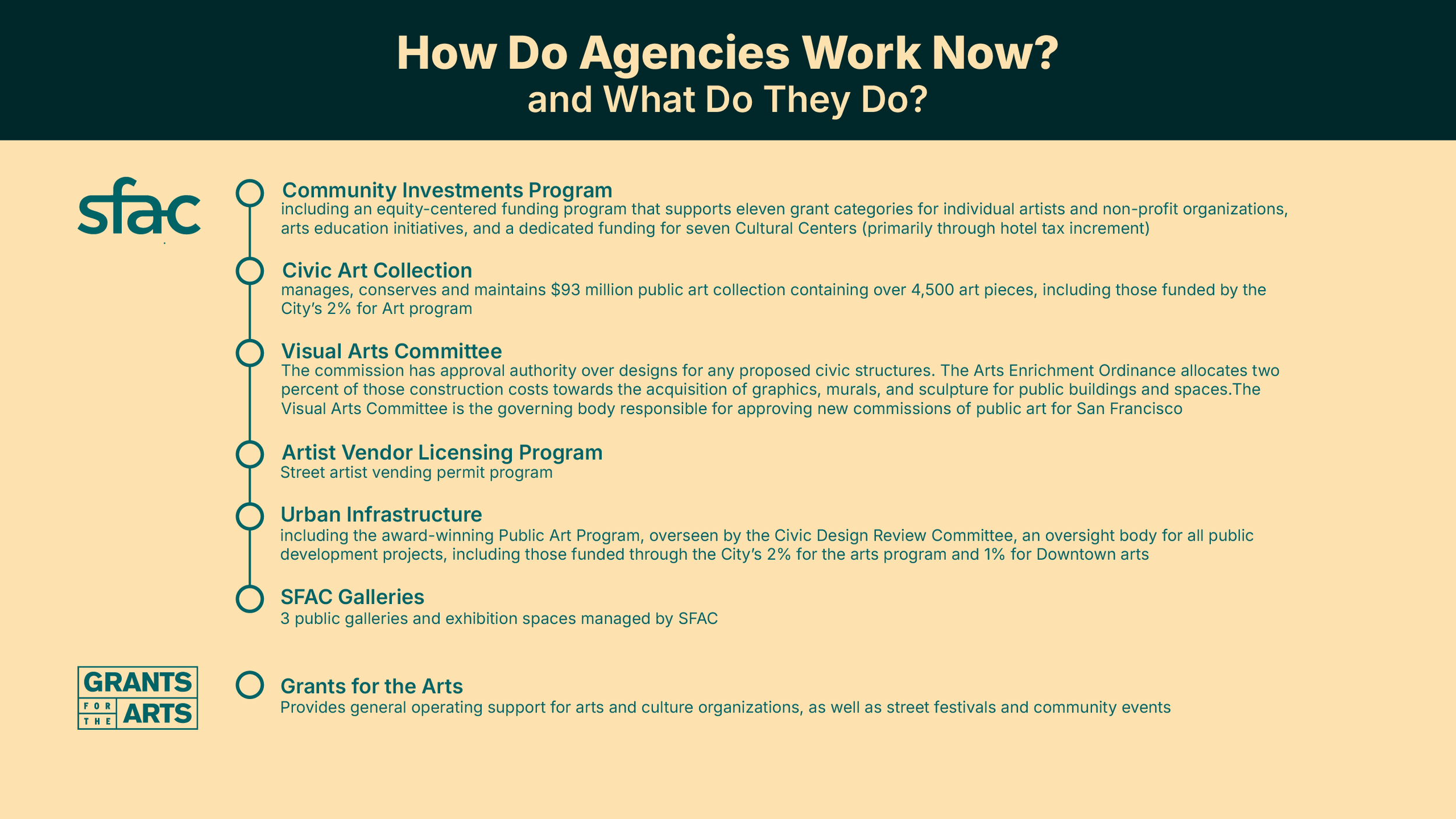
Nearly eight months after Mayor Daniel Lurie announced the merger of SFAC, GFTA and the Film SF office, a formal job posting was finally (albeit belatedly) made public for a new $268,000/year role to oversee all three arts agencies. A total of 3 community meetings were held over the course of a truncated two weeks, where the community was asked to respond to the Mayor’s “plan” – although after attending all three, PROPEL observed the limited community in attendance leaving with more questions than any clear answers as to the City’s vision for restructuring the arts – or who would be leading such a massive undertaking. In short, there was no discernible plan discussed.
After speaking with many arts leaders, the consensus has been cautious openness to treating this consolidation as an opportunity – provided there is significant public input from stakeholders. But two months into the City’s new arts executive selection process, reports continue to filter out that many of the local candidates with critical institutional knowledge and deep roots in the arts were not even granted a courtesy interview after applying.
It’s fair to say that this mayor has proven he values outside loyalists above those with public sector experience or community relationships through his Deputy Mayor selections – and in many cases, his new Department head replacements. Of note: one repeated campaign promise from Candidate Lurie in response to concerns about his lack of expertise is that he would surround himself with those who did. Although this campaign promise has fallen flat, it is not unexpected that a Chief Executive would want to replace existing city staff with their own people in a time of leadership transition.
But at a time when Trump’s DOGE has done irrevocable harm to federal infrastructure and essential public services, any consolidation or restructure of San Francisco’s local government should be considered very carefully – and with an eye toward strengthening public access and investment, not “streamlining”, privatizing or cutting it. Any additional layer of middle-management should, at bare minimum, have a deep understanding of San Francisco’s historical arts operations – (for context, the current Deputy Mayor over Arts & Culture and Housing has publicly expressed his apologies for having zero experience in either field.) And unequivocally, the community impacted by these decisions must be at the table in an authentic and transparent way. So what could that look like?
Community-Informed Arts & Culture Master Plan
Thanks to the excellent reporting from SF Examiner contributor Max Blue, SF Chronicle reporter Laura Waxmann, and longtime KQED arts correspondent Sarah Hotchkiss, arts advocates have been able to connect the dots around the troubling trend of disinvestment in arts & culture as a publicly-sustained ecosystem, despite an extraordinary concentration of local wealth. In fact, as far back as 2015, Salon.com rang the alarm about a tech boom-fueled shift away from traditional, localized arts patronage toward a more opaque, globalized art market where new tech wealth often avoids investing in local, nonprofit arts institutions.
Philanthropy is critical to supporting the arts – but to rely on the generosity of the 1% belies the reality that government can and should be the baseline foundation of support for the arts. Because art is and should be for everyone – and is connected to everything from workforce development and tourism to public health, education and cultural preservation. Art is a public service and access to it is a human right.
Some cities have partnered with the arts community to launch bold arts & culture master plans. Seattle recently launched its 2025-2030 ARTS Strategic Plan, which centers racial equity when incorporating arts into community investment, economic development and civic life. In addition, Los Angeles, Austin, and Philadelphia all have strong arts & culture master plans. As with any progressive policy, plans are only as good as a commitment to invest in their successful implementation – 2018’s Belonging in Oakland: A Cultural Development Plan is an example of a highly regarded and groundbreaking cultural plan that unfortunately never saw investment.
While the SF Arts Commission initiated a strategic master plan in 2024, it was narrowly tailored and has yet to be completed. Here’s PROPEL’s take on what elements a comprehensive and community-informed Arts & Culture Master Plan could and should focus on:
EQUITY
Integration of arts priorities across all city departments, with an emphasis on how arts & culture work can be supported through public health funding, economic development funding, dollars earmarked for race & equity programs, small business support, housing and community development funding, etc – especially when data shows that for every $1 million the City invests in the arts, it recoups a $17.5 million economic return.
Recognition that not all art & culture has to generate revenue to have value – While a strong economic return on investment is important, San Francisco’s long history as a creative hub has already set a precedent that arts & culture is a basic public service that should be accessible to all.
Work that supports cultural preservation beyond “place-making” – murals, way-finding and street banners are all wonderful tools that help give neighborhoods an identity and sense of place – but cultural preservation means longterm planning and investment in traditional craftwork and jobs, long-standing performance venues, cultural traditions undermined by gentrification, and local economies that are otherwise threatened by automation and profit-driven investment.
Invest in neighborhood arts cultural organizations that represent historically ethnic communities and cultures. It’s what makes San Francisco special, but also what drives a narrative about our future, by being rooted in a sense of our past. Particularly now, at a time when DEI policies are being villainized and defunded by Trump’s administration and corporations and foundations eager to pacify him, San Francisco should have a bold vision to keep those cultural organizations whole. For a mayoral administration concerned with city pride as a marketing tool, this should be a no-brainer. For those who remember the City’s first two marketing attempts aimed at spurring recovery post-pandemic, the cringe may still be fresh. SF Travel’s video with the always-at-risk-of-being-defunded trolley cars and the aerial shots of the Golden Gate Bridge was cheesy but expected. Advance SF’s version was even worse, a $4 million campaign led by crypto fintech villain Chris Larsen and Bob Fisher of Gap, that reduced San Francisco to a montage of tech logos. Between the two videos, the only arts, culture or even ethnic nod was a millisecond shot of Chinatown’s notable red lanterns swinging on Grant Avenue — we can do better, San Francisco.
Technical support & professional development – for small and mid-sized organizations, which tend to serve more niche communities, underrepresented demographics, and neighborhood populations. In a new world where nonprofits have been blamed for noncompliance or mismanagement of funding, there is a crucial role for city government to play in doing everything possible to set grassroots organizations up for success, make compliance and grant access easier, and provide less technically proficient organizations with the training and tools that will help them grow and thrive, ultimately contributing to the success of our overall ecosystem. It’s not an out for accountability – it’s a critical equity measure to do the best we can to create a level playing field for all.
More local arts convenings like SF Art Week– SF Art Week was a response to the perceived exclusivity of focusing FOG Fair on high-end visual art for collectors at Fort Mason, and continues to grow its offerings every year in neighborhoods across the city. The City’s longterm planning should have a mix of arts leaders at the table to help coordinate (and promote!) future efforts, including new voices with fresh perspectives. Taking a page from cities like CDMX that have created an art week that reaches into every neighborhood, public space and civic institution, as well as galleries, schools, small businesses, hotels and restaurants with art, music, performance, poetry and even food. Bring arts tourism to neighborhoods, promote local arts and incentivize interesting collaborations in order to showcase the diverse creative landscape of San Francisco. Past projects like ArtPadSF (which brought a mix of international and local artists to the Tenderloin) and MAPP (which organized performances in the Mission at local venues, including peoples’ living rooms and backyards!) were fun and inclusive. And NEXUS is doing exciting work to center Black art and artists. A cultural strategy should look at how to help these types of initiatives can grow and sustain themselves.
Respect and investment in DIY roots – Many truly beloved arts initiatives and festivals began as scrappy labors of love. With increased demand and popularity, it’s not unexpected that they will need corporate sponsors or venture-backed ticket platforms to continue their growth. We need arts at all stages, but the City can’t forget to include a strategy for nurturing and sustaining a critical part of the pipeline – independent community work. Noise Pop started out as a $5 for 5 bands show at the Kennel Club, and grew into a weeklong multi-venue event that prioritized love of the indie scene over profit. The music industry changed, and Noise Pop incorporated as a business and partnered with Another Planet Entertainment. This is worth pointing out, not to malign the current incarnation of Noise Pop, but to highlight that the City must be invested in also helping nurture new DIY initiatives that can seed this important phase of an arts & culture scene. Events like Litquake and SF Fringe Festival are just as important as larger festivals – though less capitalized. And we will always need “underground” venues, like the former Balazo Galleria.
Focus on Economic Development model versus Economic Recovery– the pandemic is over, yet the narrative remains that Downtown is the priority for investment, while neighborhoods struggle to secure a slice of the pie. Against a constant drumbeat of recovery planning (without previous recovery dollars) our solutions are geared toward one-off funding without long-term investment, Downtown block parties, corporate sponsorships, and temporary “pop-ups”. All of these interventions are great, and have a role to play – but sustaining existing institutions and work should be just as important as creating new opportunities for entertainment. Time to think about how a long-term pipeline can feed our local economy, and build something more permanent. Time to think about the needs of the whole artist through the various stages of their careers, not just a one-off gig.
EDUCATION & WORKFORCE
Real support for arts education, from public K-12 schools to higher education academia – whether it’s tracking Prop 28 arts funding for our public schools or ensuring there is a higher education to jobs pipeline, not only for teachers but to provide students with critical lifelong connections with patrons and collaborators and inroads into the local arts scene. City Hall has historically taken a hands-off approach to cultivating partnerships with academia, missing out on critical opportunities for collaboration, resource sharing and even stabilizing intervention before institutions close forever.
Develop guiding policies around AI that center human jobs and artistry – particularly in the most vulnerable arts sectors, like writing, design and the film industry, which are losing thousands of jobs every year without intervention from the government.
A “New Deal” public workforce strategy that leverages regional, state and philanthropic funding to develop new opportunities to employ artists and creative workers, including in trade apprenticeships. There are intergenerational work programs that can be implemented that pair young beginning artists with mentors, or that create skill shares. Put artists to work not only beautifying the public realm and building infrastructure, but also teaching others and problem-solving some of the city’s most intractable problems – you’d be surprised what happens when artists are at the table helping set policy.
In Bogotá, former Mayor Mockus hired over 400 professional mimes to act as “traffic controllers” at dangerous intersections – a campaign that successfully decreased traffic fatalties by almost 50%.
The New York City Department of Sanitation hired Mierle Laderman Ukeles as its first official artist-in-residence in 1977, where she created performance art focused on the essential dignity of maintenance work and the ecological toll of human consumption.
Her projects like “Touch Sanitation” where she thanked and shook the hands of all 8,500 NYC sanitation workers or “Social Mirror” where she covered a garbage truck in mirrors to make New Yorkers confront their waste, had positive impacts on public worker morale and consumer accountability.
AFFORDABILITY
A bold plan for affordable housing – Although plans are underway for new artist-specific housing on Market Street, the absolute best way to stably house artists is to just make more housing actually affordable. The lack of an affordable housing strategy has been a critical oversight of the City for years. Not only can City Hall do more to protect and preserve rent control and disincentivize evictions, it must get serious about growing a permanent funding source for affordable housing. Legislation passed in 2023 streamlined design standards and offered tax breaks for converting specific viable office buildings into housing – including exceptions for live-work homes, which wouldn’t displace existing tenants. The City could offer low-interest construction loans for the creation of arts live-work conversions, and develop artist-in-residency transitional housing on city property. We’ve created educator housing, veterans housing and women’s housing – we can support publicly subsidized artist housing, as well, with some creative vision and political will power. Most important, the Mayor could walk back his proposal to repeal a critical source of funding, 2020’s voter-approved Prop I, which has raised $400 million to date. Regardless, PROPEL is supoprting housing advocate efforts to guarantee Prop I funding with the Affordable Housing Guarantee Act – help us us get it on the November 2026 ballot!
Make it easier for artists to apply for publicly-subsidized housing – anyone who has ever had to fill out the income eligibilty verification for the Mayor’s Office of Housing and Community Development (MOHCD) knows what a grueling process it is. Artists often have 2 or 3 jobs at any given time, or none at all, and their income flucutates wildly depending on what’s in the queue. Many artists just give up on the process all-together, and would rather couch surf than deal with the exhaustive process of having MOHCD analyze every Venmo transaction in their history. The system doesn’t encourage competition – people just opt out of housing all together. (Apparently the Arts Commission has turned over the authority bestowed upon it in Supervisor Mandelman’s legislation to create “artist housing” eligibilty criteria to the Office of Economic & Workforce Development – let’s hope that OEWD is talking to actual artists about the existing problems with the City’s systems before making more…)
Protecting and investing in light industrial maker spaces and PDR – or production, distribution and repair, a zoning term that has historically covered everything from art studios and warehouses to woodshops, film production, performance rehearsal spaces, set manufacturing, floral design and traditional handcrafts like textiles, furniture design, metal and glass works. Spaces like these play a critical behind-the-scenes role in a local creative economy, feeding public-facing arts – and the City has real estate that could house public facilities, with the right planning and investment. Additionally, the City could pilot a program to legalize non-compliant but established arts live-work spaces, particularly those with an emphasis on communal work.
Innovate community models for sharing arts resources and tools – especially high-end equipment like that needed for film and video production, light industrial work, tech and computer programs, etc. The City has a nationally-recognized library system that could serve as a distribution system for tools, in exchange for volunteer hours.
Sustaining artists with a vision for quality of lifethat includes affordable healthcare, childcare and eldercare – artists are dealing with the same cost of living increases as everyone else, but often with additional financial hardships. Any arts & culture master plan should be evaluating the needs of the whole artist and how we can sustain an arts ecosystem that supports creative workers 365 days a year – as opposed to through one-off grants or pop-ups. The “struggling artist” stigma is tired and not productive – artists deserve quality physical and mental healthcare, and to receive support when they are too old to contribute at the same level that they once did.
Preservation of small and mid-size venues and rehearsal space – To have a healthy ecosystem, artists and performers need facilities that serve them and their audiences at every stage of their careers. With real estate at a premium and operating costs skyrocketing, the number of venue closures has had a profound impact on the local arts scene. In the first tech boom, the closure of so many live music venues and all-ages spaces left a void. The Office of Economic & Workforce Development (OEWD) has done some thinking about potential policy solutions, but it must be actualized soon. Artists are still raw at the closures of Bottom of the Hill and Thee Parkside – because they know they won’t be the last ones, if the City doesn’t act quickly.
ACCOUNTABLE GOVERNANCE
A cultural assets and real estate audit – Anyone who has ever sat through a Capital Planning Committee meeting knows how difficult it is to get any coordinated long-term plan for maintaining, rehabbing, relocating or redeveloping San Francisco’s vast arts real estate portfolio. Arts and cultural facilities are always last on the list of priorities, but this has to change. Additionally, deed-restricted cultural assets in the former Redevelopment Area of Yerba Buena deserve a fresh look and a real city plan for managing the future of the “museum district”.
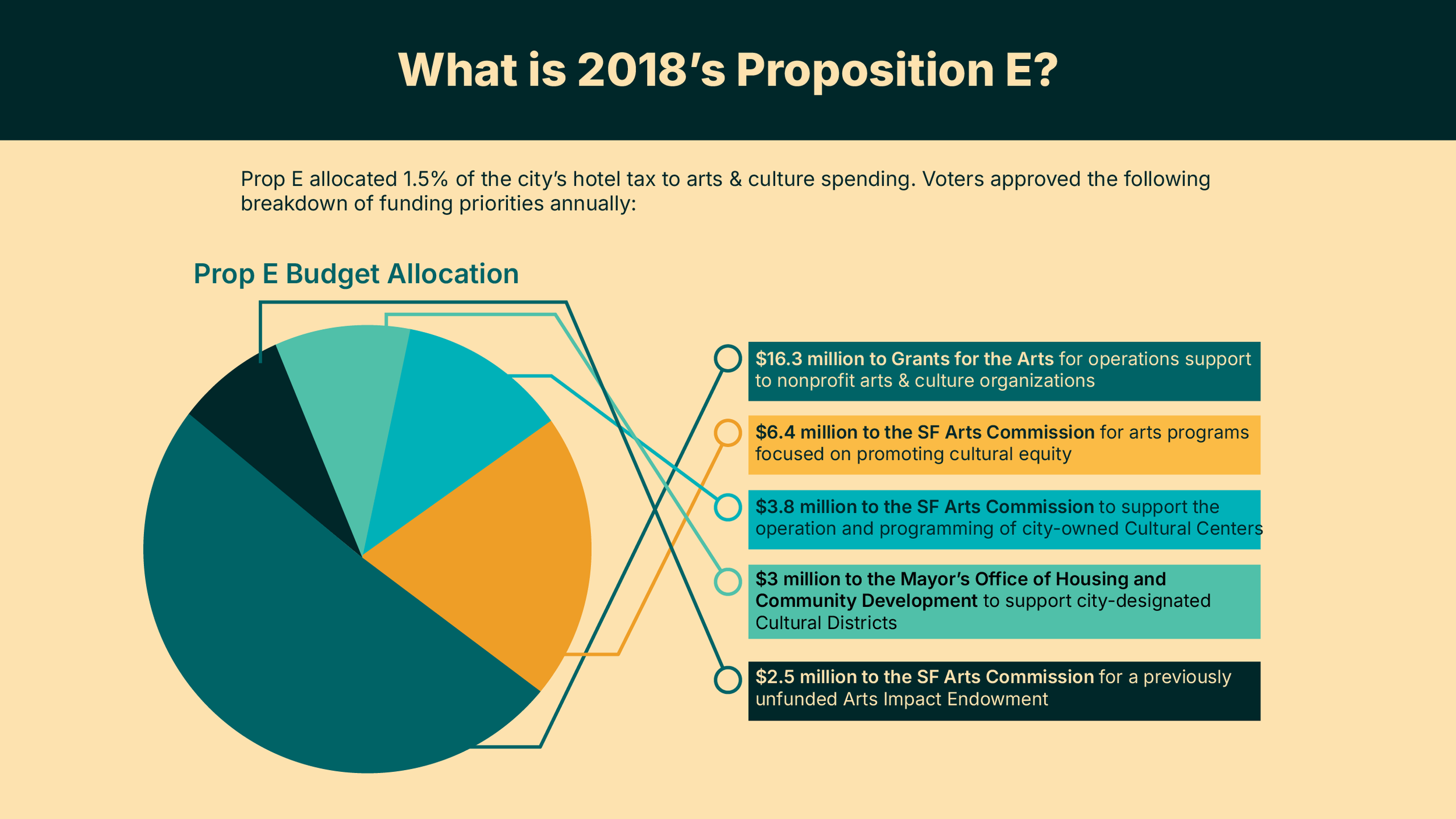
Real commitment to growing local dedicated funding for arts investment — While 74% of San Francisco voters approved 2018’s Proposition E, which allocated a small percentage of the city’s hotel tax to arts & culture programming, funding cuts continue to hammer the arts community. There must be a broader vision for how arts & culture receive public funding beyond a reliance solely on the Prop E baseline (which, in and of itself deserves an audit to ensure the City is complying with its voter-mandated allocations). The City should have a clear budget breakdown of all public funding sources that touch the arts, and be willing to explore growing the pot for specific needs that are not currently addressed within Prop E – particularly as the Mayor’s Office has expressed a desire to “give more money to more people”. (We’re still waiting to hear a clear proposal on how the Mayor proposed to do this…)
Bring back arts reporting – the City has media contracts for things like public noticing with select newspapers, but could expand to partner with local arts reporters on monthly arts round-ups and promotions of a diversity of shows and exhibits — if we invest in arts as worthy of reporting on and critiquing, media outlets will employ reporters in that field
Maintain the SF Arts Commission independent oversight and governance authorities – The SFAC is not just an oversight commission, it’s also a city agency with distinct governance roles. The 2024 Prop E Commission Streamlining Task Force has made a final report of recommendations to the Mayor and Board to remove the voter mandates of these governance and oversight functions from the Charter. It would not only undermine the will of voters to gut an independent body of experts tasked with steering arts approvals and policy, but it would hinder the agency’s ability to perform key city functions
Expand enforceable oversight to include Rec & Park properties – so that “temporary” installations don’t get plopped down into our public parks without some kind of transparent public comment process — especially for extant artworks underwritten by private donors.
Create transparency around behested funds, particularly the Downtown fund established by the Mayor’s Office. Public-private partnerships are key to growing and sustaining the arts, but there must be clear criteria and transparent accounting of how, why, and for who funds are being spent.
Ultimately, any plan – as well as the selection of a new Director of Arts & Cultural Affairs – should have robust community process. Late job postings with truncated application windows, a total of three community meetings within two weeks to “solicit feedback” on a mega-merger proposal that has yet to be defined, and recent reportbacks on the closed-door hiring process are all cause for concern. Hopefully, the Mayor’s Office sees the valuable opportunity for partnership with longtime arts community membersand works collaboratively to realize a truly equitable and bold vision for sustaining and elevating artists and culture workers in the future.
How Can You Get Involved?
Join a group like Artists for a Better Bay Area to get educated and trained as an advocate and get involved in the ongoing budget fight through June 2026, as well as the Mayor’s restructuring of arts agencies
Pledge your support to get the Affordable Housing Guarantee on the ballot.
Email Board President Rafael Mandelman and the Board of Supervisors demanding the SF Arts Commission governance and oversight authorities remain in the Charter