Building a Bridge Over the Fiscal Cliff
A vision for San Francisco’s public schools
In recent weeks, SFUSD has finally admitted that they are sitting on a $429 million fund surplus.
That acknowledgement is a critical first step toward undoing years of bad budgeting. The district has pursued harmful budget cuts year after year, based on massive deficit predictions and underestimated revenue projections that just weren’t true.
The self-defeating narrative amplified by the media is that public schools are on the decline and deep cuts will need to continue no matter what we do. Even if new money is discovered, we are told by district leaders that spending it will drive us off a “fiscal cliff”. Starving our schools of resources leads families to avoid our public schools, which leads to further divestment through a pattern of declining enrollment. No one is offering a long-term vision for building the school district San Francisco families deserve.
What if instead of starving our public schools of resources, we use our massive reserve fund to invest and build a bridge to a better future?
We all want San Francisco to have great public schools.
We can achieve this through a surge of investment in public education to create the world-class public schools our students deserve. Reversing the SFUSD doom loop will require us to look at budgeting differently and to end the structural dysfunction in how we do budgets.
Here are the steps we can take now to build a bridge over the fiscal cliff:
Make accurate budget projections so we can hire full-time staff instead of more costly and less stable private contractors
Right-size the reserve so it’s in line with state law
Invest in our schools to improve learning conditions and student outcomes
If we take these steps, we can attract world-class educators, strengthen our programs, improve student outcomes—and attract families back to SFUSD, thus increasing revenues and improving our financial position. This is our vision for rebuilding our public schools. Our students can’t wait: Please join us!
1. Make accurate budget projections so we can hire full-time staff instead of more costly and less stable private contractors
SFUSD’s pattern of disinvestment has been driven by consistent and dramatic under-projections of revenue. This chart shows how SFUSD has dramatically under-projected revenue by at least about $80 million every year in recent history:
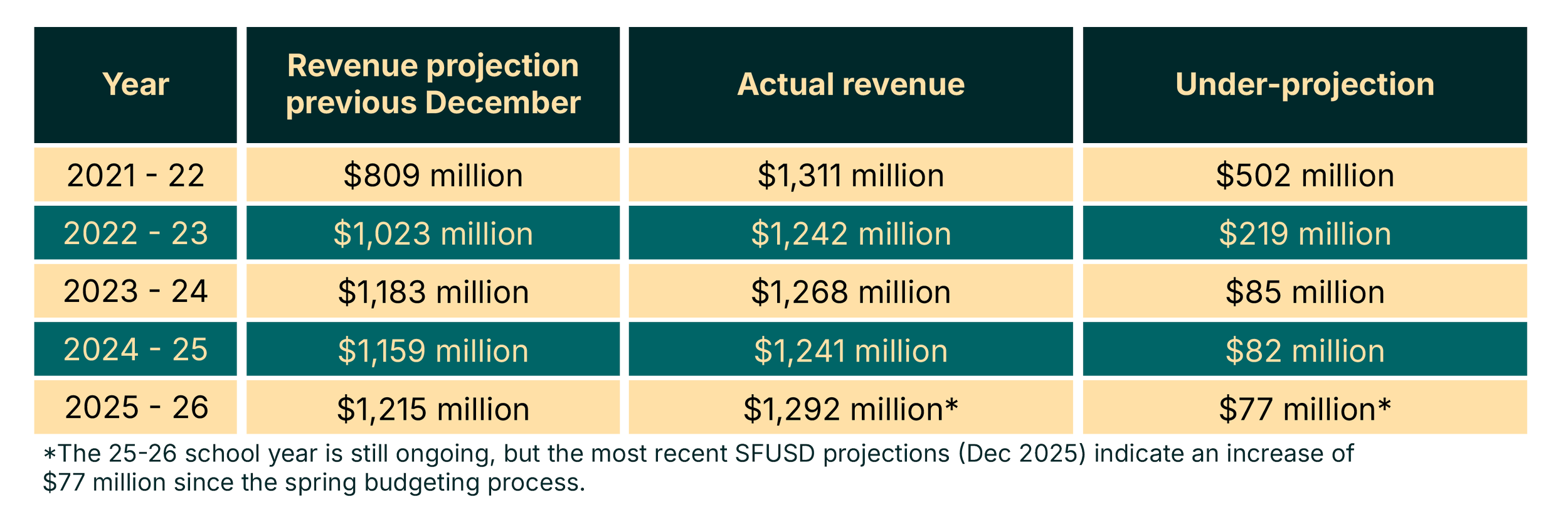
*The 25-26 school year is still ongoing, but the most recent SFUSD projections (Dec 2025) indicate an increase of $77 million since the spring budgeting process.
For the 2026-27 school year, SFUSD says it expects a deficit of $81 million. But if revenue projections are again $80 million short as they have been for years, next year’s budget is already balanced, meaning no harmful cuts to schools are needed—and we have money available to invest in our educators, so we can fully staff our schools.
If we start making accurate budget projections, especially around revenue, we can stop cutting SFUSD programs and giving handouts to private equity companies through expensive contracts. We can attract and retain qualified staff for every single position in SFUSD, so our kids, especially our special education students, have the full-time educators they deserve. SFUSD can take its place where it should be, among the “positive outlier” school districts in California which have strong and stable teaching forces—and better student outcomes.
Why does the district keep underestimating revenue?
Who benefits from this inaccurate under-prediction of revenue? In many cases, it’s for-profit companies who provide services to public schools as private contractors. When a public school district erroneously takes $80 million off the table during the spring budgeting process, it’s too late to put those funds back into school site budgets. The district can’t hire additional staff or give raises to existing staff to afford the cost of living. This results in staff shortages, especially in areas like special education. Districts then must hire private companies to provide temporary staff or do tutoring, usually at much higher costs.
A recent report called Spending More, Serving Less: The High Cost of Private Equity in Special Education shows how this dynamic plays out in West Contra Costa School District, where private equity firms made $14 million on special education contracts during the 2024-25 school year. SFUSD has hundreds of staff vacancies, especially in special education, and has contracted with the same private equity firms, Stepping Stones and Soliant Healthcare, to hire contracted educators that have no union protections. Trump administration Education Secretary Linda McMahon has touted the virtues of such private equity firms as part of her plan for privatizing public schools.
2. Right-size the reserve so it's in line with state law
SFUSD’s inaccurate “sky is falling” revenue projections have produced huge surpluses, and we now have a $429 million reserve— about 35% of our General Fund.
Most of us understand that this huge stockpile of taxpayer dollars ought to be spent down responsibly to serve today’s kids. But current district leaders say we need an enormous reserve fund in order to avoid state receivership. The San Francisco Chronicle recently repeated a false claim that the state of California recommends a 17% reserve. Although fiscal hawks love to throw around the 17% figure, it has never been recommended by the state.
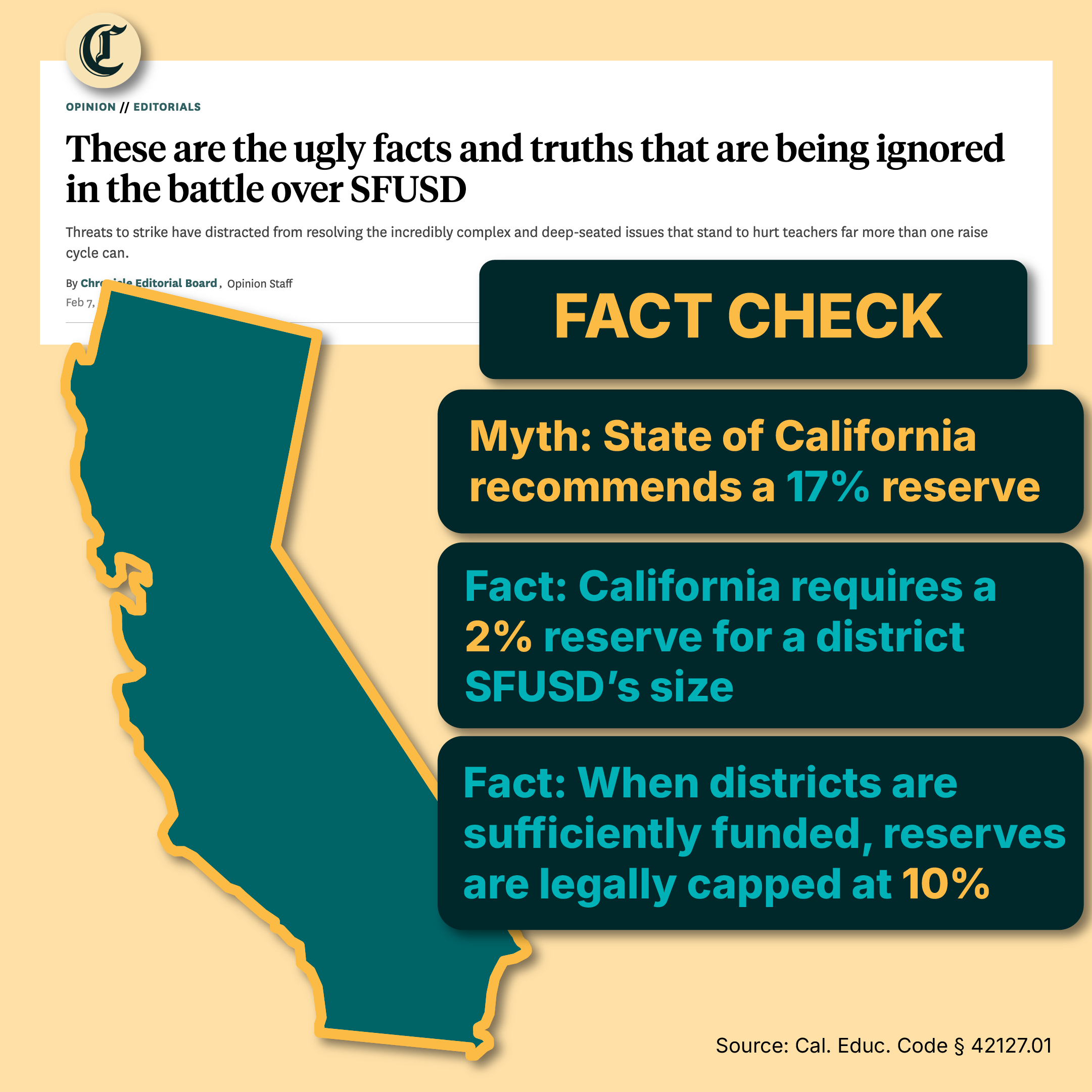
In fact, California requires a 2% reserve for a district of SFUSD’s size.
And in years when the state’s own school reserve has sufficient funds, California law puts a 10% cap on local school district reserves. These common-sense, balanced reserve guidelines are designed to ensure that districts are not hoarding public dollars that are intended to improve student outcomes for today’s kids.
SFUSD has recently cited its $68 million monthly payroll as justification for a large reserve—as if the state of California might suddenly stop funding local school districts and require SFUSD to keep paying its staff for several months with no new funding coming in from the state. This is an absurd apocalyptic scenario that shows the extent to which fear drives thinking on this issue.
To reverse SFUSD’s doom loop, we need to set a sustainable reserve policy consistent with state law, not the advice of fiscal austerity extremists—so we can spend today’s dollars on today’s kids.
There is a school district in California that has done exactly this: San Diego Unified. Years ago, San Diego decided to keep reserve levels near the state required level so it could invest in its students. What’s the result? San Diego has a strong and stable teaching force, and is a “positive outlier” district in California, with strong student outcomes, especially for students of color and low-income students.
3. Invest in our schools to improve learning conditions and student outcomes
Successful school districts like San Diego know that money matters in public education, which is why they invest today’s dollars in today’s students. There is a direct link between investing in schools and improving student outcomes: increasing per pupil spending by 10% increases the chance of high school graduation by 7 percentage points.
Unfortunately, here in San Francisco, our district leaders are saying we can’t invest in our schools because most of the available surplus funds are “one-time” or “restricted”. The truth is there is no legal constraint on spending reserve funds for ongoing expenses, it just requires careful planning.
After admitting the $429 million reserve fund that has accumulated, not through careful planning, but due to wildly inaccurate budget projections, SFUSD recently confirmed to the Chronicle that $221 million of this money is officially “unrestricted” and can be legally spent on anything SFUSD does.
The other $208 million is technically listed as “restricted”— but in many cases the restrictions are very broad. For example, local funding sources such as QTEA and PEEF are considered “restricted” even though they pay for general educator salaries and benefits. In the 2024-25 school year, a majority (56%) of SFUSD’s expenses were “restricted.” While some of the restricted reserves are reserved for very specific purposes, others are much more flexible. “Restricted” money, like all the taxpayer dollars we receive, can and should be spent to benefit kids and improve student outcomes today—not set aside for an imagined calamity in the future.
Another argument we hear in the press is that “one-time funds” cannot be used to pay for ongoing expenses. But a large amount of “one time” money can be spent responsibly by dividing it across multiple years. For example, we could invest $200 million by spending $50 million a year for 4 years, making sure the money is spent strategically to improve learning conditions and student outcomes while we work to secure additional state and local funding for our public schools to sustain these investments.
The austerity crowd will reply that after four years, we’ll run out of the money and there will be a “fiscal cliff.” But budgets are notoriously hard to predict more than 3 years out (the state only requires 3 years of projections). Today’s community-led efforts to get California to increase its investment in public schools may pay off by then—and in the meantime, San Francisco can show it’s doing the work to leverage our local dollars. Spent wisely, these proactive investments will likely result in more families and educators choosing to join and stay in SFUSD, leading to increased enrollment and increased revenue.
First and foremost, the reserve should be activated to ensure fully staffed schools. Decades of research show that educator quality and experience are the primary drivers of student outcomes. California’s "positive outlier” school districts, such as San Diego, have strong and stable teaching forces.
We can also use the reserve to grow specific programs that have been shown to produce better student outcomes, such as the Teaching Through Problem Solving and Lesson Study project at John Muir Elementary School, which has now been expanded at other SFUSD schools. Programs like this may look “expensive” because they require more staff to coach and support teachers—but when we see the dramatic increases in student outcomes, the investment clearly pays off.
Finally, we can use the reserve to maintain and strengthen programs that attract families to SFUSD—such as the special education, language immersion, newcomer, and arts programs that are currently on the chopping block.
Investments like these are the bridge SFUSD needs to get across the fiscal cliff.
Of course we don’t know exactly what will happen—but why would we take hundreds of millions of dollars off the table now and preemptively undermine the quality of our public schools?
Leaving a massive reserve fund untouched is a choice, not a requirement.
With a reserve this size, we don’t have to choose between the contracts our educators need and the programs that serve our students. We can do both.
Let’s fight for a vision for the fully-funded public schools San Francisco deserves.
Let’s adjust our budgeting practices to balance fiscal responsibility with our mandate to provide today’s students with a world-class education.
Let’s invest the resources we have now to strengthen our schools and attract world-class educators.
Let’s build a bridge together.
This follow-up to “Supporting SF Schools With Real Numbers” was researched and co-authored by:
Maggie Furey, school social worker
Nathan Horrell, parent leader
Matt Alexander, school board member
Ali Uscilka, parent leader